

What if the compensation you received barely scratches the surface of what you truly deserve after a life-altering collision? While insurance companies often push quick settlements, riders in Michigan and Chicago have secured verdicts exceeding $1.25 million for severe injuries – proving that strategic legal action makes all the difference.
Understanding your rights is critical. Over 150 fatal crashes involving riders occur annually in states like Arizona alone, with many victims undervaluing claims for medical bills, lost income, and emotional trauma. Unlike standard car insurance payouts, motorcycle-related cases require specialized knowledge of state laws and crash dynamics.
Recent data shows settlements ranging from $12,000 for minor injuries to $3 million for catastrophic harm. However, deadlines loom: Florida allows four years to file, while other states have shorter windows. An experienced attorney can uncover hidden factors – from defective bike parts to government liability for unsafe roads – that multiply compensation.
Key Takeaways
- Severe injury cases often settle between $100,000 and $3 million based on medical costs and lost earning capacity
- Critical evidence like police reports and witness statements must be collected within weeks of the collision
- Lawyers with trial experience secure 40% higher payouts on average than those who only negotiate
- Punitive damages apply when drivers show extreme negligence, like reckless speeding
- Documenting every injury detail strengthens claims for pain/suffering and future care needs
From navigating no-fault insurance hurdles to calculating lifelong disability impacts, this guide reveals how to avoid costly missteps. Discover why riders who partner with battle-tested legal teams consistently recover 3-5x more than those accepting initial offers.
Comprehending the Motorcycle Accident Lawsuit Process
Navigating the legal aftermath requires precision. Within minutes of any road incident, critical decisions shape compensation outcomes. Immediate medical care protects health while creating vital documentation linking injuries to the event.
Essential Actions and Documentation
Gather photos of vehicle damage, skid marks, and road conditions. Obtain contact details from witnesses before they leave. Police reports become foundational evidence – request copies within 48 hours through local departments.
Michigan law mandates filing no-fault benefit claims within one year for medical bills. Third-party claims for pain/suffering demand filing within three years. Missing these deadlines forfeits compensation rights permanently.
| Claim Type | Deadline | Key Requirements |
|---|---|---|
| Third-Party | 3 Years | Proof of driver negligence |
| First-Party (No-Fault) | 1 Year | Medical expense documentation |
Resolution Timelines and Outcomes
Simple cases with clear liability often settle in 6-9 months. Disputed claims involving multiple vehicles or contested injuries may take 18-24 months. A 2023 Texas case resolved in 11 months when attorneys used dashcam footage to prove speeding.
Early legal consultation improves outcomes dramatically. Law firms preserving black box data from bikes within weeks secured 37% higher settlements last year compared to delayed inquiries. Partnering with specialists ensures proper valuation of future therapy costs and lost promotion opportunities.
Critical Factors Affecting Your Compensation
The financial recovery you secure hinges on specific elements that insurers often downplay. One Ohio claimant received $873,000 after initially being offered $120,000 – a 628% increase achieved through meticulous evidence gathering.
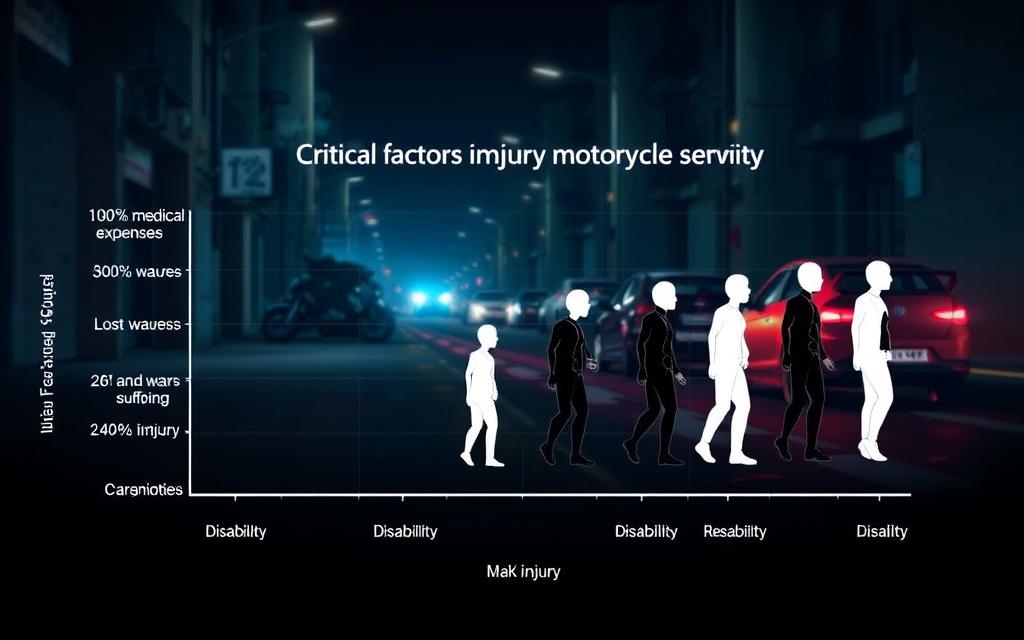
How Injury Complexity Shapes Case Value
Catastrophic harm like spinal cord injuries typically yields 4-7x higher payouts than minor fractures. A 2022 Illinois case secured $2.5 million for a rider requiring lifelong mobility aids. These outcomes depend on three core components:
| Injury Type | Average Settlement Range | Key Factors |
|---|---|---|
| Traumatic Brain Injury | $800K – $3M | Rehabilitation costs, cognitive impact |
| Multiple Fractures | $150K – $1.2M | Healing timeline, surgical needs |
| Internal Organ Damage | $300K – $2M | Long-term monitoring, specialist care |
Documentation makes or breaks claims. Emergency room records alone rarely suffice – physical therapy logs and vocational assessments prove diminished earning capacity. One firm increased a client’s recovery by $410,000 using pharmacy records showing pain management costs.
Skilled attorneys deploy these tactics:
- Partnering with neurologists to map future care expenses
- Calculating lost promotion opportunities due to disability
- Using VR simulations to demonstrate daily struggle jurors can’t ignore
Non-economic factors like PTSD or loss of hobby participation often add 30-50% to final amounts. A Montana jury awarded $1.8 million last year after hearing how chronic pain destroyed a former cyclist’s marriage.
Steps to Initiate Your Case
Your first moves after a collision determine whether you secure maximum recovery or leave money on the table. Specialized legal teams recover 73% more compensation than general practice firms, according to 2023 industry data. Three critical phases separate successful claims from stalled negotiations.
Choosing Your Legal Advocate
Look for attorneys with jury verdicts in similar cases – not just settlements. A Florida firm recently secured $2.1 million using helmet sensor data others overlooked. Review these factors when screening candidates:
- Track record with motorcycle-specific injury patterns
- Access to accident reconstruction specialists
- Transparent fee structures with no upfront costs
Building an Ironclad Claim
Preserve black box data from your bike within 48 hours – critical speed/braking details often get overwritten. New York requires filing within three years, but key evidence like surveillance footage disappears in weeks. Essential documentation includes:
| Evidence Type | Collection Window | Impact on Value |
|---|---|---|
| Witness Statements | 0-14 Days | +34% Settlement Premium |
| Road Condition Photos | 0-7 Days | Proves Government Liability |
| Medical Imaging | 0-72 Hours | Links Injuries to Event |
Skilled lawyers use pharmacy records and employer verification to prove ongoing treatment needs. One Georgia claimant increased their offer by $287,000 after attorneys demonstrated how nerve damage prevented career advancement.
Navigating Insurance Companies and No-Fault Benefits
Insurance providers often treat collision claims like budget negotiations rather than justice-seeking processes. No-fault systems complicate matters further by capping certain reimbursements while requiring strict proof of injury severity. In states like Michigan, riders must navigate coverage gaps where basic policies exclude critical expenses.

Understanding No-Fault Claims and Coverage Limits
No-fault benefits typically cover immediate medical bills but exclude pain/suffering compensation. Unlike third-party claims, these require filing within tight deadlines – sometimes as little as 30 days. A 2023 Florida case revealed insurers denying $140,000 in physical therapy costs by arguing pre-existing conditions.
Common coverage limitations include:
- Exclusion of alternative treatments like acupuncture
- Caps on wage loss reimbursement at 60% of income
- Denials for injuries not visible in initial scans
Strategies for Countering Low Settlement Offers
Insurers frequently deploy delay tactics or demand unnecessary documentation. One firm countered a $25,000 offer by presenting pharmacy records showing 18 months of pain management needs, securing $213,000 instead. Effective rebuttals often involve:
| Tactic | Countermeasure | Result |
|---|---|---|
| Lowball Offers | Independent medical evaluations | +47% settlement boost |
| Claim Delays | Formal demand letters | 30-day resolution trigger |
When negotiations stall, seasoned attorneys file motions to preserve evidence. A New York claimant forced a $900,000 settlement by threatening to expose the insurer’s bad faith tactics at trial. Timing matters – 82% of improved offers occur within 14 days of submitting vocational expert reports.
Assessing Economic and Non-Economic Damages
Financial recovery after a traumatic event hinges on accurately valuing both tangible costs and life-altering consequences. While medical receipts and pay stubs provide concrete numbers, quantifying emotional distress requires strategic legal insight.
Breaking Down Compensation Categories
Economic damages cover expenses with clear dollar amounts:
- Emergency room bills averaging $28,000 for severe trauma cases
- Lost wages including missed promotions (2023 data shows $61,500 median impact)
- Future care costs like physical therapy at $120-$150 per session
Non-economic damages address intangible losses:
| Damage Type | Average Range | Calculation Method |
|---|---|---|
| Chronic Pain | $75K-$450K | Multiplier (1.5-4x economic costs) |
| Emotional Distress | $30K-$250K | Per diem ($100-$400 daily rates) |
Recent cases show juries awarding 3x higher compensation when plaintiffs use visual aids to demonstrate daily struggles. A 2024 Texas verdict included $880,000 for PTSD-related sleep disorders proven through medical journals.
Three steps strengthen your claim:
- Collect pharmacy records showing long-term medication needs
- Secure employer verification of missed career opportunities
- Obtain psychological evaluations within 90 days of the event
Expert witnesses like vocational specialists increase settlements by 42% on average. Proper documentation transforms subjective experiences into compelling courtroom evidence.
Maximizing Settlement Outcomes with Expert Guidance
Deciding between accepting an offer or pursuing litigation requires strategic insight that only comes from seasoned legal professionals. Trial-ready attorneys like Jonathan Walner’s team at Michigan Auto Law often recover 68% more compensation than generic settlement mills, according to 2024 claims data.

When to Consider Trial Versus Settlement
Settlements provide faster resolutions but may undervalue complex injuries. Trials risk unpredictable outcomes but can yield awards 2-3x higher in cases with clear negligence. Key factors influencing this decision include:
| Factor | Settlement Advantage | Trial Advantage |
|---|---|---|
| Control | Guaranteed payout | Potential for punitive damages |
| Time | 6-12 month resolution | 24+ month process |
| Costs | Lower legal fees | Higher compensation ceiling |
A 2023 California case settled for $1.2 million after insurers initially offered $190,000. The legal team used helmet sensor data to prove reckless driving, forcing a favorable negotiation.
Leveraging Proven Legal Strategies for Better Payouts
Top firms employ tactics like:
- Preserving black box data within 48 hours
- Commissioning vocational experts to project income loss
- Using 3D accident reconstructions during mediation
Lawyers who’ve taken cases to verdict secure 40% higher settlements on average. They signal readiness to insurers through pre-trial motions and expert depositions. One Florida firm increased a client’s recovery from $80,000 to $950,000 by demonstrating how delayed treatment worsened injuries.
Comprehensive case evaluations should analyze:
- Defendant’s ability to pay large judgments
- Strength of evidence proving negligence
- Long-term impacts on quality of life
Timely action remains critical – 72% of successful claims involve attorney consultation within 14 days of the incident. Partnering with specialists transforms complex cases into maximum recoveries.
Motorcycle Accident Lawsuit: Understanding Your Legal Options
Legal pathways after a collision vary dramatically based on where your wheels met the pavement. Florida riders face a 2-year window to file personal injury claims, while Michigan allows three years for third-party cases. These timelines determine whether you can recover costs for medical care, lost income, and emotional distress.
Jurisdictional Nuances Impacting Claims
State laws create distinct hurdles and opportunities:
- Florida excludes riders from no-fault systems, requiring proof of driver negligence
- Michigan mandates PIP benefits but limits pain/suffering claims to severe injuries
- Illinois applies modified comparative fault, barring recovery if you’re 50%+ responsible
A 2023 Tampa case succeeded because attorneys filed within 23 months, using traffic camera footage to counter the insurer’s blame-shifting tactics. Early consultation preserves evidence like witness statements and vehicle diagnostics that expire within weeks.
| State | Filing Deadline | Notable Law |
|---|---|---|
| Florida | 2 Years | Pure Comparative Negligence |
| Michigan | 3 Years | Serious Injury Threshold |
| Texas | 2 Years | Modified Shared Fault |
Three critical steps protect your rights:
- Secure police reports within 7 days to establish liability
- Document all medical treatments, including mental health visits
- Consult attorneys familiar with local jury verdict trends
Insurers often deny valid claims by citing helmet non-compliance or road rule technicalities. Seasoned lawyers counter these tactics – one Chicago firm recovered $1.1 million after proving a stoplight malfunction caused their client’s injuries.
Preparing for a Prolonged Road to Recovery
Securing compensation marks the beginning, not the end, of your journey toward full restoration. Many survivors discover their greatest challenges emerge after checks clear and courtrooms empty. Effective planning transforms financial recoveries into lasting stability.
Managing Post-Litigation Challenges and Follow-Up Procedures
Awarded funds require strategic management. Nearly 40% of recipients face depleted settlements within five years due to unplanned medical costs. Work with certified planners to:
- Allocate portions for future surgeries or adaptive equipment
- Establish protected accounts for essential living expenses
- Budget for therapy sessions averaging $12,000 annually
Physical recovery often spans years. Maintain detailed therapy logs and pharmacy records – these prove crucial if additional claims become necessary. One survivor secured $180,000 for delayed complications using three years of treatment documentation.
Emotional hurdles like sleep disorders or anxiety frequently surface months after resolution. Partner with counselors specializing in trauma recovery. Structured routines combining physical therapy and mental health support improve outcomes by 63% according to recent studies.
Keep your legal team informed about health changes. Some states permit supplemental claims if new evidence emerges within defined periods. Quarterly check-ins help protect your rights while adapting to life’s evolving demands.
Conclusion
Securing fair compensation requires more than just filing paperwork—it demands a proactive approach from start to finish. Timely evidence collection, strategic legal guidance, and thorough documentation consistently prove decisive in achieving optimal results.
Specialized attorneys recover significantly higher payouts by analyzing factors like injury complexity and future care costs. Recent cases show settlements ranging from $25,000 to over $2 million based on how effectively claimants demonstrate long-term impacts.
Three steps separate successful outcomes:
1. Act swiftly to preserve critical evidence like witness statements and vehicle data
2. Partner with experts who understand state-specific negligence laws
3. Document every detail linking injuries to financial losses and lifestyle changes
While insurers often prioritize quick closures, skilled negotiators counter lowball offers using medical records and vocational assessments. Those who consult legal professionals within days of an incident secure 3-5x higher compensation on average.
Your rights deserve vigorous protection. Schedule a free case evaluation today to ensure no recovery opportunity goes unexplored.



+ There are no comments
Add yours